Good Value High Quality Bordeaux Wine: Chateau Montjouan

Chateau Montjouan is a wine with personality. It’s stylish, elegant and beautifully balanced – definitely a cut above its peers and well worth trying for yourself. The 2006 Chateau Montjouan Tradition, Premières Côtes de Bordeaux is a very dark crimson with rich flavours of cassis, blackberries, cedar, cigar box and spice with a little hint of pepper. The tannins are well integrated and the wine is supple with good length. Chateau Montjouan has been in the hands of the Yung family since 2003 and I highly recommend it. The family have three other estates in the Premières Côtes de Bordeaux and Cadillac: Chateaux Grimont, Sissan and Tour Saint Paul.

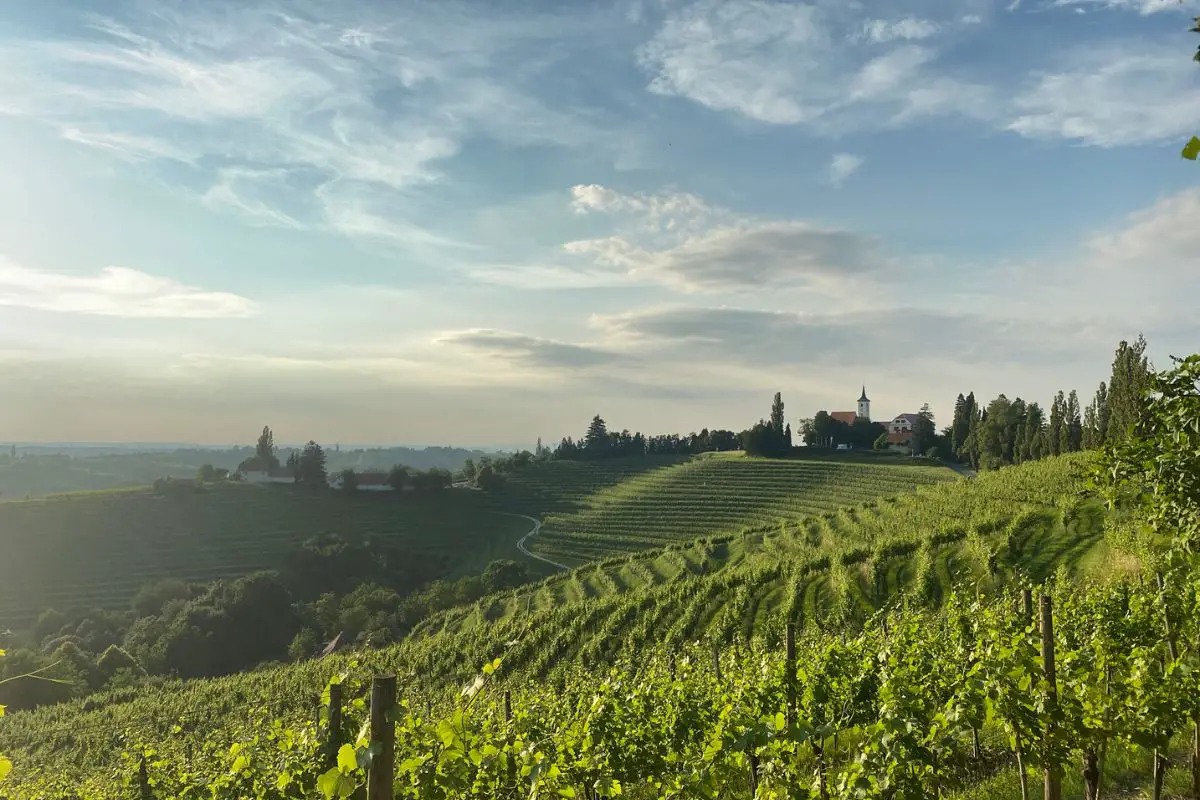
The Montjouan vineyards are relatively small and cover only 20 acres and lie in Bouilac – a small village that sits right on the bank of the River Garonne. Bouilac is only a mile or so from the City of Bordeaux. The little village is clustered with mansions and chateaux that hail from a time when the merchants of Bordeaux were prospering from their trade at the Port of the Moon and built beautiful properties on the hillside at Bouilac as country retreats.

Chateau Montjouan is also a wine with a story. Wine makers will tell you that there is a story behind every bottle and sometimes the story behind the smallest and least known chateaux can be quite surprising. The little known Montjouan has a link to one of the most famous places in Bordeaux . . .

Chateau Montjouan‘s vineyard lies on clay gravel and chalk and actually overlooks the river. The vineyard is ancient, dating back to the 1500s but local legend has it that it may date back further for the chateau and its vineyard are reputed to have been owned by ‘Blessed’ Pey Berland (c1375 – 1458). Berland was born a peasant in the Medoc but rose to fame as Archbishop of Bordeaux in 1430, wielding immense power at a pivotal point in French history.

During Pey Berland’s tenure France and England were in the throes of the last years of the Hundred Years War. His reputation is that of an intelligent and wise man who remained modest and took great care of those in need.

Initially he supported the English in their struggle against the French to retain Bordeaux but he was appalled by the martyrdom of Joan of Arc. Twice he went to plead with Henry VI of England but his endeavours fell on deaf ears so he transferred his allegiance to Charles VII, King of France. Berland went on to become one of the most influential figures in Medieval Bordeaux and was instrumental in bringing about the submission of the whole province to the French Crown, and with the ending of the Hundred Years’ War.

Before Berland’s rise to Archbishop he was pastor of Bouilac and in 1413 he decided to fortify the 6th century village church so that it could serve as a refuge in case of alarm. His family owned property in the foothills of Bouilac and Berland purchased a vineyard near the church to supply wines for Mass and lived in a country house called Potager de Jouan which gave its name to Chateau Montjouan.

In Medieval times the clergy, monks and nuns used potagers to provide flowers, medicinal herbs, fruit and vegetables for the inhabitants of the church, abbey or monastery. Potagers were quite different to English kitchen gardens as they geometric and often included an arbour or a trellis of vines. So it seems that Chateau Montjouan‘s wines were used for communion nearly 600 years go.

Many of Pey Berland’s works live on – he founded the University of Bordeaux in 1441, Saint André Hospital and a number of colleges and secondary schools. He bequeathed all his books to the college he established in his birth town of Saint Raphael and he also created a fund to help purchase books for poor students at other institutions. The lasting landmark that most people associate with him still stands – the bell tower that he had built at Saint André Cathedral, known as the Tour Pey Berland. He is remembered with affection by the people of Bordeaux and his name is still honoured today!

So, next time I am in Bordeaux and hurrying across the Place de Pey Berland that stretches in front of the great cathedral and its tower I will think of the little vineyard at Montjouan and its elegant wine. If you’d like to try the 2006 you’ll find it available at Bordeaux-Undiscovered available with free delivery if you order a case of 12 wines. Cheers!

Posted in Bordeaux News, Chateaux Profiles | Leave a comment

Good Value, High Quality Bordeaux Wine: Chateau Vrai Caillou

Bordeaux hs been hitting the headlines with the focus on the wines it is most famous for – the great Grand Cru Classes that are collected, relished and treasured throughout the globe. However Bordeaux has a wide range of high quality, good value wines that are simply pushed out of the headlines that most of us simply miss out on. The rural backwaters of Bordeaux produce some fantastic wines that slip under the radar. The wines of Bordeaux have been part of the region’s history for so long that they are an inseparable part of its culture with tiny villages supporting ancient domaines where wine making is part of everyday life. Times change and with it so do wine making practices – they have improved under the shadow of their grander peers and there are many admirable wines available if you know where to look.

Appellations slip in and out of favour down the centuries and you’ll often find that wines from lesser known appellations today were sometimes the most desired in the past. Likewise chateaux rise and fall but one thing that does not change is the potential of the land they were raised on. Enterprising wine makers frequently re-discover the long lost potential in a crumbling estate with neglected, forgotten vines and surprise their critics by working hard, investing savings and effort to bring great wines back to life.

Families of wine makers often go back generations and where the wine is renowned locally it quickly becomes snapped up – never reaching the larger market outside France, sometimes not even outside Bordeaux!

With the price of wine rising and the poor choice available in our supermarkets these wines offer an excellent alternative as they are reasonably priced and very well made. They are overlooked by the big chains as they come from small producers who do not make the volumes needed to stack shelves countrywide and can not produce wines for the mass market.

It is these hidden gems that I want to concentrate on in my next series of blogs. The first chateau I would like to introduce you to is Chateau Vrai Caillou. The chateau’s name literally translated means ‘The True Chateau of Rock’. You might think this is an odd name but there is a story behind it.

Firstly ‘caillou’ means ‘pebble, stones or rock’ and you can find examples of chateaux named after pebbles dotted across Bordeaux – an example of a Grand Cru Classe so named is the Second Growth Chateau Ducru Beaucaillou (meaning ‘beautiful pebbles’). Why name a chateau after rocks you might ask? Because the stony ground it sits on is vitally important for growing the vines – most great vineyards lie on slopes or hillsides of gravelly or limestone based soils as vines need good drainage. Chateau Vrai Caillou lies on around 200 acres of clay-limestone and is located in the small village of Soussac in the Entre Deux Mers, on the high plateau of the range that divides waters between the Dordogne and the Garonne rivers. Chateau Vrai Caillou sits on the slopes of Butte de Launay, the highest point in the region.

Secondly the reason Chateau Vrai Caillou is known as ‘The True Chateau of Rock’ stems from the fact that centuries ago it was originally known as Chateau Caillou. Since 1863, Chateau Vrai Caillou has been owned by the Pommier family and its wines were noted in the famed Bordeaux wine directory Cocks & Féret in 1879. As was common in this period in time the chateau grew other crops as well as vines but when the Pommiers decided to concentrate on wine making as their sole industry in 1920 they discovered that another chateau had registered the name of Chateau Caillou, in Sauternes. Rather than change the name of their chateau Odette Pommier’s response was: “Ah! Yes, is there another Caillou? Then, mine will be the true (Vrai) one!” And that is the story of how the chateau got it’s name.

The Entre Deux Mers is one of those regions that is undervalued nowadays but in the past it was a hive of activity and wine making. It is criss crossed with Roman roads (one runs through Soussac) and the landscape is peppered with historical forts and Medieval châteaux, mills, churches and monasteries. Wine production here dates back to Gallo Roman times but it was the Benedictine Monks in the Middle Ages who helped to create the reputation of this region and its wines. The reason that the region attracted monastic settlement is that one of the most important pilgrimage routes in the Christian world runs right through it: the route de Santiago de Compostella (the ‘Way of Saint James’). It was nicknamed the Milky Way by travellers, as according to legend, the Milky Way was formed from the dust raised by travelling pilgrims. It was the ‘road under the stars’ and the pale arm of the Milky Way stretched out and pointed the way to the edge of the known world: Compostela itself means ‘field of stars‘.

I think that is a rather good analogy for the little chateaux scattered across the area – and Vrai Caillou is one of these ‘stars’. The Pommiers make both red and white wines – both are good and well worth seeking out. The red Chateau Vrai Caillou Bordeaux Superieur 2009 is an elegant, silky, traditional claret with good structure and supple, well balanced tannins. The bouquet is packed with ripe black cherry and cassis and the flavour is full of layers of intense blackcurrants, violets, vanilla, earth and spice.

The blend is 60% Merlot, 20% Cabernet Sauvignon and 20% Bouchet. Bouchet is the local name for Cabernet Franc – which is thought to be native to the area. It’s known that the infamous Cardinal Richelieu, who was also Duke of Fronsac (another lesser known appellation in Bordeaux that produces excellent wines) transported cuttings of his favourite grape Bouchet to the Loire Valley where they were planted at the Abbey of Bourgueil. Oddly enough there is a Chateau de Bouchet in Grezillac (only 13 miles away from Vrai Caillou) which is now owned by Marc and Agnes Lurton (from the famous Lurton family that own many top chateaux in Bordeaux) – so may be the story that Cabernet Franc is native to the area has some substance.

The white Chateau Vrai Caillou ‘Les Vignes de la Garene’ 2010 is aclear white/green tinted colour and has aromas of melon, ripe fig and acacia blossom. This is a bright, fresh and elegant wine with flavours of peach and lemon and a hint of smoke and spice. The blend is 70% Sauvignon Blanc, 20% Semillon and 10% Muscadelle – the classic grape varieties that make the dry Bordeaux white wines. Both wines cost £9.74 and are extremely good value for the money. Both are available at Bordeaux-Undiscovered for under £10 a bottle delivered to your door when you order a case of 12 bottles and I hope that you will try them – and discover two little stars for yourself.

Posted in Bordeaux News, Chateaux Profiles | Leave a comment

Lafite Battles Lafake in China

Whilst writing about the market for Bordeaux wines in China recently I mentioned that the combined trading volume of faked and genuine Chateau Lafite Rothschild in China is estimated to be between 2 million and 3 million bottles annually. Quite a few of you were surprised at the sheer volume (and criminal ingenuity) of the fake bottles and counterfeiters. I have Chris Penwarden of SingaPoured to thank for the title of this blog as it was he who coined ‘Lafake’ and having looked into the situation it does seem as if Lafite have a battle on their hands.

It seems that counterfeiters have been selling ‘Lafite Castel’, ‘Lafite Empire,’ ‘Lafite Field’, ‘Lafite Race’, ‘Zhuhai Lafite,’ ‘Lafite Nobles,’ ‘Baron Lafite’, ‘Golden Lafite’, ‘Silver Lafite’, ‘Royal Lafite,’ ‘Duke Lafite,’and ‘Lafite Family.’

Not unsurprisingly Lafite has launched a full intellectual property protection campaign in China and have already won 6 lawsuits against Chinese companies selling fake Lafite. Shanghai Daily reported that by the end of 2011, the company had filed more 160 trademark lawsuits against companies trying to benefit from Lafite’s reputation and 5,000 bottles of fake wine had been seized by police and market watchdogs. Christophe Salin, CEO of Lafite, told the press that “if things go well, with the cooperation of the Chinese government, fake Lafite will be eradicated within two years.”

Lafite’s battle with Lafake is that it is damaging its brand. The Global Times have pointed out that as China is not a mature market for wine what most of the consumers care about is the label on the bottle, not the taste of the wine. Sommelier Duan Lian said that: Almost 90% of the Lafite sold in China is fake. The prevalence of counterfeits has gradually driven consumers away from the brand and eroded its value.”

The more I read about counterfeiting in China the more amazed I become – there are unofficial stories about secret floating Lafite wine factories on ocean going cargo vessels:

Liu Zhihui, vice chairman of the realty subcommittee of Asia-Pacific Urban Development Association, claimed on his microblog that he was told that an agent was producing counterfeit Lafite wine in a secret wine factory on a cargo ship through blending low quality French wine in fake Lafite bottles and selling it to various outlets in China.”

It’s a costly problem – and a potentially dangerous one – some of the fakes don’t even contain anything resembling wine but are a chemical soup of alcohol additives, perfume and colouring mixed together.

Posted in Bordeaux News, Chateaux Profiles, China | 4 Comments

My Thoughts on the Future of Bordeaux Wines

The rumours have now become a reality and it looks as if the chateaux are releasing their wines and prices before Parker releases his scores. Whether this is a wise move or not time will tell. In the past when chateaux have released their wines before Parker’s scores they did so thinking that they wouldn’t get a good review from Parker himself. This was the case in 2008 when Parker praised the vintage and offered good scores to many chateaux who felt very sore because they could have released at higher prices if they had waited. They have never forgotten this – at the time I heard rumours that the chateaux owners were somewhat grieved they weren’t able to maximise on their prices.

You may or may not be aware that Lafite released their wines yesterday. The price to us UK Wine Merchants is at 420 – 430 euros and the price to the Negotiants (French Wine Merchants), from whom we buy, was at 350 euros. For UK Wine Merchants to make a profit they generally put a 10% margin on top of their purchase price and from within that margin they have to transport the wine from Bordeaux on a rising cost basis due to fuel costs and insurance. As the value of the wine has increased substantially over recent years the cost of insurance has also soared. Therefore after the UK Wine Merchants have taken their costs into account there is not much profit. I am not asking you to get your violins out but I believe there is some confusion as to who buys what and at what prices – I hope this clarifies the situation.

On a more poignant note my guess is that Lafite, who reputedly made 200 million euros net profit last year, may be being used as a guinea pig by the First Growths to see how this price is received by the market. The caveat this year is that they are only releasing 1/3rd of their production and to receive any sort of allocation of Lafite UK Merchants are being asked to commit to buying Rieussec, L’Evangile and Dassault.

As for pricing of Lafite this year all this being considered – and more importantly the quality of the 2011 vintage – I believe a fairer price for UK Wine Merchants should have been around 220 – 230 euros. Therefore I am astonished at the price of 420 euros (not forgetting the added burden of the caveat) . . . and will not be buying. I really don’t think this is an investment wine but that it is a drinking wine and I think that a fair price to wine lovers and consumers should have been somewhere around 275 euros.

As far as the other wines that Lafite are asking us to support I would suggest that Rieussec would be good, considering that 2011 is such a good year for Sauternes and the Dry Whites. But, sadly, who wants X number of cases of Sauternes in the cellar alongside 1 case of Lafite?

This now brings into question the whole En Primeur system and why are they releasing so little? I think this sends out a warning to the market of things to come in the future, My suspicion is that as Asia doesn’t like to buy wines that aren’t ‘physical’ (ie futures) the chateaux are trying to maximise their situation by holding stock back this year which will enable them to release wines when later bottled. Many of the major chateaux in Bordeaux are currently enlarging their cellars giving them the facility to release when they like.

If this is the case those chateaux who do go it alone will have to adopt a steep learning curve in how to conduct themselves in the open market without the luxury of a negotiant covering their flanks. I have noticed that some chateaux seem to be gearing themselves up to work directly with the markets by employing ex-negotiants within their marketing departments. A sign of the future perhaps?

However by adopting this policy are the chateaux owners being naïve in remaining loyal to their Asian market, ignoring traditional markets and hoping to profiteer? If my suspicions are correct and major chateaux follow Latour‘s lead this will cause much animosity within the market – not only to the end customer but within the supply chain. It’s a risky strategy which possibly may well work if the vintages are good or above average (such as the 2009 or 2010) but will it work with poor or mediocre vintages?

If I am correct in my thoughts the real loser will be the traditional markets. That said if Asia becomes unstable in any way and fails to buy the wines (I was recently told that a 31 million euro order from China for the 2010 vintage was cancelled – which affected 10 leading negotiants in Bordeaux) how will the traditional markets react should Bordeaux look to them once more?

I think that what is happening in Bordeaux is very unsettling for the market. I stand by my previous comment in that this year let ‘Buyer Beware’ if they are considering buying 2011 En Primeur. Wines could come down in price – as they did in 2007 – and you might be wiser to keep your money in your pocket till things have settled down a bit.

Posted in Bordeaux News, Chateaux Profiles, En Primeur 2011 | 2 Comments

Will Top Chateau Now Sell Direct to Consumers? . . . ‘Latour Stops Selling En Primeur’

Chateau Latour announced on Friday that it will no longer continue to sell wine at En Primeur from 2012. Instead they will keep complete control of their wine and sell it when they consider it to be ready for drinking – which could mean that some vintages will not be released for years. To me it also indicates the beginning of the end and I can see Latour doing away with the courtier/negotiant system and selling direct.

It’s something that we have talked about in the wine world, and something that I have written about in the past. (see En Primeur 2009 blogs). I can see the other First Growths – and some of the other Grand Cru Classé – following suit if they have sufficient reserves of back vintages (which a lot of the top chateaux do) and sufficient funds to cope with the dip in their cash flow till the new system picks up.

As Chris Kissack (aka the Wine Doctor) points out in his excellent coverage of the story Latour will become more expensive due to its exclusivity and perfect provenance.

James Suckling notes that Asian wine lovers prefer their wines in bottle and are nervous of buying En Primeur which explains Latour’s logic in part. He quotes Frederic Engerer of Latour as saying: “We need to adapt to consumer demand. We are seeing the wine consumers and lovers living differently. It’s rarer and rarer that people buy wine and age it in the same place for 20 or 30 years.”

Hamish Wakes-Miller of Bella Wines has confirmed that in the wine trade we have all known that something was astir for a while – chateau were stock piling vintages and, expensive new cellars, storage facilities and chais are being built. Hamish also reports that: “Chateau Latour had changed their philosophy over the years. They had severely cut the amount of negociants with whom they dealt. They had savagely cut people who had loyally bought and promoted their wines.”

Of course the majority of chateaux in Bordeaux can not do away with En Primeur – they rely on the cash flow (which is why the system was set up 100 years ago in the first place). What will probably happen is that the top chateaux will break away from the En Primeur and Courtier/Negotiant system and form an elite group that sell and distribute their own wines, controlling the price and the quantities released. Check out Vinalytics for a good report on possible business models that Latour could adopt.

It’s interesting that Latour waited till now, a poor vintage, to announce their news – if they had done it with the 2010 they may have benefited from the speculative buzz that would erupt about ‘when’ people could get hold of the sought after wine. And that’s one thing that Latour might find they have overlooked in all this – buzz. En Primeur is full of it. How will Latour market their wines without attending En Primeur? It’s the one set time of year where thousands of wine merchants, critics, journalists and enthusiasts are concentrated in one place to do one thing – taste the new vintage. Their reports are read by thousands of wine lovers who eagerly anticipate the next review. If Latour starts releasing wine when they feel like it they are in danger of disappearing off the radar . . . En Primeur focuses the world’s attention whereas a single release from Latour, no matter how much it is fanfared, can not attract that kind of publicity.

Posted in Bordeaux News, Chateaux Profiles, En Primeur 2011 | Leave a comment

Korea and Wine – Market Opportunities?

Joshua Hall of Wine Korea had written an interesting article in the Asia Edition of the Wall Street Journal about the unintended consequences of Korea’s Free Trade Agreements (FTAs) on wine consumption in the country. South Korea is currently within the top 5 wine consuming countries in Asia. Although its wine market felt the impact of the global financial crisis some people feel that it is now showing a renewed momentum of growth.

In terms of import volume, as at 2011, Chile holds the top slot (FTA with Korea in 2004), followed by Spain, France and Italy (FTA with Korea 2011). In terms of import value, France comes in as the top, followed by Chile, Italy and the USA (FTA with Korea 2012).

Joshua writes that on their own the FTAs have not had a huge effect on consumption but they are: “leading to challenges to other government policies that impinge importers’ ability to sell wine more cheaply. Seoul sold the Korean public the trade deals by promising they would make goods cheaper for consumers. Now the government is under pressure to deliver.”

He reports that last year a consumer-rights group singled out a Chilean wine brand whose prices had risen despite implementation of the FTA:

After witnessing the popular uproar over that Chilean wine, retailers and importers are proactively cutting prices to avoid similar treatment in the media. On the day the U.S. agreement came into effect last month, major importers offered permanent price reductions of 10-14% on American wine on store shelves, taking a loss on existing stocks on which they had already paid the 15% duty. Hypermarket chain and department store Lotte promoted American wines with discounts of 30-40% to mark the FTA’s implementation.

This in turn is creating new opportunities for American wineries, which already enjoy several advantages. Koreans find the names of American wines less intimidating than those of Europeans, and perceive American wines as being easier to learn about. Americans also have a secret weapon: Korean-Americans. More Korean-American entrepreneurs are entering the wine business, driven by a passion for Californian wines and benefiting from an understanding of Korean culture.”

As Joshua points out, none of this guarantees American success: “Italian wines haven’t boomed despite lower tariffs and 700 Italian restaurants in Seoul, due to lack of co-ordination among regional marketing bodies in Italy and limited marketing investment in Korea. Americans will want to emulate Chilean wineries, who invested heavily in advertising, wine events and cross-marketing with fashionable products.”

According to press reports the most popular wine in Korea is the Chilean Montes Alpha Cabernet Sauvignon.

It’s thought that the Italians could fall by the wayside if the USA gets its marketing strategy right and over takes them for third place in the import value stakes. Up until now the strength of Italian wines has been based on sweet wines like Moscatos just over a year ago Wine Consumer Reports (sponsored by the JoongAng Ilbo and Winenara, a Korean wine retail chain) named the top 5 Italian wines – 4 of which were Moscato, with 1 Riesling. The Korea Times reported earlier this year that the popularity of Italian table wines in the 20,000-60,000 won price range has been poor and that this lack of diversity is beginning to hurt Italian wines in Korea.

However despite the battle between rival wine producing countries with FTAs with Korea Joshua points out that they are at least creating new business opportunities and focussing Korean consumers on wine. So it seems that little by little Korea is opening up – which, with 49 million potential wine drinkers, will present an irresistible ‘carrot’ to wine producers in both the Old and New Worlds.

If you are interested in following developments in the Korean wine market – not to mention Korean food – check out Joshua Hall’s excellent site Wine Korea.


Posted in Korea, Wine News | Leave a comment

Can China Help Bordeaux Out of Slump?

An article in China Daily ‘Bordeaux looks to China Amid Slump‘ reports that Bordeaux chateaux are looking for more Chinese investors:

“Their investment will create a win-win situation since many chateaux are currently experiencing sluggish business and an ever-shrinking market,” said Pierre Goguet, president of the Chamber of Commerce and Industry of Bordeaux, during a promotional event for the China Dalian International Wine & Dine Festival, which is set to open on July 12th.

Commenting on the market hitting the doldrums Goguet said he is optimistic about the investment outlook:

“More merger deals will mean better growth for those brands that boast quality and time-honoured products.”

Goguet plans to bring representatives of 9 enterprises from the region to China to meet investors. Chinese winemakers have also launched a campaign to team up with world-class chateaux overseas.

The article mentions Chateau Lafites new vineyard in Shandong province which is a joint venture with Domaines Barons de Rothschild and Chinese investment firm CITIC which has cost 100 million yuan ($15.87 million) so far. Apparently, within China, the combined trading volume of faked and genuine Lafite is estimated to be between 2 million and 3 million bottles annually. That’s one heck of a lot of fake Lafite – the chateau only produces approximately 45,000 cases annually, of which between 15,000 – 20,000 are of the First Wine!

Last year COFCO bought Chateau Viaud and it’s wine business is growing 15% every year according to the company’s president Wu Fei.

The Haichang (Group) Co Ltd, which bought 8 chateaux in Bordeaux, “each worth more than 10 million euros ($14 million)”, has used them to establish a new brand called Lamont. Johnny Wang, Vice President, said that:

“Differentiated strategies for the operation and marketing of the products are key to future development.”

In addition, Haichang has injected a total of 3 billion yuan to build a 333-hectare Dalian International Wine Industry Park in the Dalian Bonded Zone last December and considers wine culture, tourism and trade “three driving forces for growth”. Haichang will build Asia’s largest wine museum to foster a more sophisticated local wine culture.

The Haichang Group have 4 major business enterprises: petrochemicals, oil transportation and freight, real estate investment and business tourism. They already have two tourist resorts in Dalian: Golden Pebble Discoveryland and Polar Aquarium, plus at least 8 more planned in medium sized cities such as Yantai, Chongqing, Chengdu, Wuhan, Hangzhou and Tianjin.

Statistics showed that China’s retail wine sales hit 70 billion yuan last year and industry research firm Wine Intelligence indicated that the demand for wine among Chinese consumers will maintain an annual growth rate of 18.5% in the next few years.

Posted in Bordeaux News, China | Leave a comment

BBC Good Food Show

We are at the BBC Good Food Show at Bluewater in Kent from Thursday 12th – Sunday 15th April and if you are in the area we would love to meet you! We are at Stand E22 which is on the main perimeter aisle.

CORRECTION – just arrived at the Show and our stand has been changed to E32!

This is a brand new Spring event for the BBC Good Food Show and will feature 150 of the best producers of fine food and drink, suppliers of the best kitchenware as well as live cookery demonstrations from popular BBC TV shows and celebrity chefs as well as seek advice from wine experts.

An audience of 14,000 people are expected and every ticket includes a seat in the Supertheatre where you can see top chefs cooking live including James Martin with Saturday Kitchen. Celebrities attending are:

John Torode and Gregg Wallace with MasterChef

Gino D’Acampo – resident chef on This Morning and King of the Jungle!

Henry and Tom HerbertThe Fabulous Baker Brothers

Genaro Contaldo – He is widely known as the Italian legend who taught Jamie Oliver all he knows about Italian cooking and regularly appears on Saturday Kitchen, Market Kitchen, Jamie at Home, Jamie’s Italy and Jamie’s Kitchen.

Richard Philips – obtained his first Michelin starred restaurant at only 29 and regularly appears on Lorraine, Ready Steady Cook, Saturday Kitchen and Daily Cooks Challenge. Most recently, Richard appeared as the guest chef on GMTV.

Thomasina Miers – winner of MasterChef 2005.

Olly Smith – wine expert, television presenter, wine editor of Live Magazine in the Mail on Sunday.

Jo Wheatley -Great British Bake Off winner.

Peter Richards – Master of Wine and appears regularly on Saturday Kitchen.

Ewan Lacey – wine expert on The Cookery School.

Susy Atkins – wine expert, weekly columnist for the Sunday Telegraph Stella magazine, drinks editor of Delicious magazine and regularly appears on Saturday Kitchen.

Shelina Permalloo – winner of  MasterChef 2012

Lawrence Keogh – Chef at the renowned Wolseley restaurant located in London’s Green Park. Lawrence has cooked for a number of dignitaries and royals, including the Queen Mother, Margaret Thatcher and the late Kin Hussein of Jordan. He regularly appears on Saturday Kitchen, Market Kitchen and Food Poker.

Cyrus Todiwala OBE – Executive Chef of Café Spice Namasté and Mr Todiwala’s Kitchen, both stylish pan-Indian restaurants and appears regularly Food and Drink, UK Today, Saturday Kitchen, Drop Down Menu, and the BBC World Service.

For directions and further details, including ticket prices and booking please visit the BBC Good Food Show’s website here. Hope to see you there!

Posted in Bordeaux News, Shows and Events | 2 Comments

En Primeur 2011 Summary

Having arrived back from Bordeaux and taken stock of all my tasting experiences I am sure there are many Bordeaux chateaux owners who are very disappointed with their wines this year.

This is a year that has been extremely difficult for them where statistics have proved that the growing season was very taxing with problems during flowering and intense heat on the grapes when they were not yet fully ripe. Many of the producers have had to discard a lot of unripe/green grapes and coupled with some chateaux experiencing hail during flowering this has reduced the yield.

During the growing season it is imperative to prune foliage away from the grapes to give maximum exposure to the sun so that they can ripen. Many chateaux however went through this pruning process early only to find that the grapes became exposed to intense heat which resulted in the grapes being scorched. A lot of chateaux are down on yield for the above reasons – in some cases up to 50% down, with some chateaux admitting to me that they were unsure whether they were going to get a crop or not. In some cases it may have been more prudent for some chateaux to do as they do in Sauternes – which is that if they are not happy with the conditions then they do not produce any wine.

There have been reports claiming record attendance at the tastings this year but in my experience I thought the numbers were down. It was easier to get appointments with the chateaux this year and the Asian influence just did not seem to be there.

I have heard the 2011 vintage being described using a variety of adjectives such as ‘unique’, ‘classic’, ‘peculiar’, ‘different’ and a ‘drinking’ vintage. This tells me that even the Bordelaise are totally confused by what has happened this year and as a consequence they are confused by the wine that they have produced. When making wine the chateaux look for a good balance between alcohol and acidity – the 2010 vintage was a classic example where both the alcohol and acidity were at reasonably high levels and therefore the wine had good balance. This year however the alcohol is down – on average wines are 13 – 13.5% – but the acidity has remained high and this therefore gives the wine an imbalance. The reality of the vintage to me is that I don’t feel it’s ‘classic’, I don’t feel it’s ‘unique’, I feel it is ‘unusual’.

Having read some of the reports on my return from Bordeaux I think many people are confused at what to write and how describe it. Is it a ‘drinking’ vintage? Time will tell. You will have to wait a long time to be able to drink it as many wines need the tannins to disappear and in some cases I think this will be hard to achieve.

There have been the exceptions where chateaux – through their dexterity and knowledge – have been able to produce a reasonable effort but in all honesty I think they would admit that at best their efforts have only produced mediocrity. Mother Nature has been unkind to the chateaux this year – where She saved them in 2008 and blessed them in 2009 and 2010, She has turned her back on them in 2011. Those chateaux that have done reasonably well have to be congratulated on their efforts.

Where Mother Nature was kind was to the dry whites and the sweet wines of Sauternes and Barsac. As with the 2007 vintage these wines are excellent. The sweet wines were opulent, fresh, clean and full of fruit and I believe 2011 will be a vintage that is ranked amongst the best. The dry whites proved to be a success with many chateaux making good quality whites within their stables.

So, what does the Bordeaux enthusiast do? Do they buy? Or not? Erring on the side of caution I can’t really say that this is a vintage to buy at En Primeur for either investment or drinking. Should you want to buy I believe you would be better advised to look at back vintages such as 2008, 2009 and 2010. I have read that 2011 is supposed to be a better vintage than 2008 but my experiences of tasting over the last week tell me that I cannot agree with this statement. 2008 offered far more fruit and better balance. I have written about the exceptions to the norm in 2011 but you must bear in mind that you are comparing wines from a mediocre vintage and therefore some will taste better than others – but to say that they are better than other vintages is an overstatement.

For those of you who wish to buy the 2011 at ‘En Primeur’ the saying Caveat Emptor comes to mind – ‘Buyer Beware’.

Posted in En Primeur 2011 | Leave a comment

En Primeur 2011 – Saint Emilion, Pavie Macquin, Angelus, Pressac, Montlabert and La Fleur Morange

My final set of tastings were the wines of Saint Emilion and the Right Bank properties. As we all know by now it has been a very taxing year for the wine makers and this seems to have affected both Banks to me. I feel that the balance of acidity is out of kilter this year. However there are some notable exceptions that you should watch out for.

Pavie Macquin (85% Merlot, 14% Cabernet Franc, 1 % Cabernet Sauvignon) showed pretty well and I think Angelus (50% Merlot, 47% Cabernet Franc, 3% Cabernet Sauvignon) will turn out to be a powerful wine.

I thought that one of the lesser known chateaux, de Pressac, was very interesting – partly because of the blend of grapes (72% Merlot, 14% Cabernet Franc, 12% Cabernet Sauvignon, 1% Carmenere, 1% Malbec) but also because it showed well in the mouth and has some promise. Malbec is known as ‘Pressac’ in Bordeaux and local lore has it that it acquired its name when Vassal Montviel of the Chateau de Pressac introduced it there between 1737 – 1747. Many in the area did the same and the grape became known as Pressac Noir. Years later a Hungarian peasant by the name of Malbeck took the grape to the Medoc and it acquired the name Malbec (to learn more click here).

Another wine worth mentioning is Montlabert (80% Merlot, 20% Cabernet Franc) which was well balanced and came across very well in the mouth compared to its peers.

I also visited La Fleur Morange with a number of people, one of whom I have recently met here in Bordeaux, Andrew McGinty – who became very popular due to his fantastic lingual skills enabling him to act as interpreter, explaining how the chateau owner Jean Francois made the vintage – thanks Andrew!

The Grand Vin itself (50% Merlot, 50% Cabernet Franc) showed the opulence you expect from a good wine and was well balanced. We were fortunate enough to also taste the 2010 – which proved to be an extremely good wine. Having tasted both I think that the 2011 is not far behind the quality of last year’s vintage. Mathilde (100% Merlot) , the second wine, was also well balanced with lots of fruit and had good structure.

Jean Francois explained that he didn’t cut back the foliage from the vines to expose the grapes until very late as he wanted the leaves to protect the grapes. He had his leg pulled by other wine makers for waiting but it proved to be a wise move in the end as others saw their grapes scorched – which is why few wines have had opulence this year.

I hope you have enjoyed my coverage on the 2011 vintage – I think people have to understand the characteristics of the vintage this year and that it is a year that has not been easy for the Bordelaise wine makers. I will sum up my thoughts early next week.

Posted in En Primeur 2011 | 3 Comments